Meaningful new artworks light up TasTAFE’s Alanvale Campus
Published on: 10 Dec 2025
Caleb Nichols-Mansell (left) with his artwork 'Kanamaluka' at Alanvale Campus.
Three brilliant new artworks by Tasmanian Aboriginal artist Caleb Nichols-Mansell are lighting up TasTAFE’s Alanvale Campus in Launceston – as colourful and dynamic as they are deeply meaningful.
The artworks were commissioned under the Tasmanian Government’s Art Site Scheme, managed by Arts Tasmania – and are part of a broader $7.5 million building upgrade at Alanvale.
This project has delivered 2 new facilities: a Heath Hub community services training facility, focused on youth work and mental health support; and a welcoming taypani Learner Hub where learners can connect with Client Central, library and online resources, and each other.
The name ‘taypani’ comes from palawa kani, the Tasmanian Aboriginal language, meaning ‘to come’ – a fitting name for a space designed to bring people together.
Both of these new spaces feature glorious mural-like artworks by Caleb Nichols-Mansell, acknowledging the 3 clans connected to Country – Panina, Tayarinutipana and Litarimirinar – creating delight and intrigue for learners, staff and visitors alike.
“These works are intended to act like quiet anchors in busy learning environments. They’re large and present, but also calm in tone, so people can sit with them over time,” Caleb said.
A proud Pakana man with deep connections to Country, community and culture, Caleb is based on Tasmania’s north-west coast, working across the island and nationally as an artist, designer and creative consultant.
Tasmanian Aboriginal culture was always present when Caleb was growing up – in stories around the dinner table, in time spent on Country, and in the way his family talked about justice, history and survival.
“At home I was taught to be proud of who I am; at school I was often told Tasmanian Aboriginal people didn’t exist – so I grew up negotiating those 2 realities,” Caleb said.
“That tension has shaped a lot of my work. I realised art could be a powerful way to celebrate Tasmanian Aboriginal culture, to challenge old narratives, and to create space for our stories in the built environment – a way to assert that we are still here, that our stories are alive, and that our connection to Country is ongoing.”
Much like the free-flowing lines in his artworks, Caleb has established himself as an artist organically, without formal training, taking his cues from mentors.
“A lot of my ‘training’ has come from Elders, community leaders, and peers who’ve mentored me in cultural protocol, storytelling and responsibility,” said Caleb.
“My early commissions were very modest – posters and digital artworks for community organisations. But each one led to something slightly bigger, and over time that grew into large-scale public, festival and institutional commissions. Every commission becomes another classroom!”
Beyond his work with TasTAFE, Caleb is now collaborating with organisations as diverse as the Launceston General Hospital, Devonport City Council, MONA, the Tasmania JackJumpers, Lifeline Australia and the Tasmanian Symphony Orchestra.
Caleb’s Alanvale artworks began life as detailed digital illustrations, built-up through layers of fine linework and colour. From there, they were translated into large-format, high-resolution prints and integrated into the architecture.
Installation was quick – around 1 week. But as Caleb noted, “The real time investment was in making sure the concepts were right for the site and for community, before anything went onto the walls.”
Caleb put a lot of thought into this process, weaving a narrative through the 3 works to capture “the stories, forms and flow of northern Lutruwita: the way rivers move, the way ridgelines hold our histories, and the way community moves through these buildings every day.”
In the taypani Learner Hub, Kanamaluka (pictured above) stretches along the upper library wall and is inspired by Kanamaluka/River Tamar. “Long bands of colour move like water and ridgelines, creating a sense of motion and continuity across the space,” Caleb said.
Our Island Home is a more literal outline of Lutruwita, filled with fine, flowing linework that follows coastlines, rivers, contours and nation borders. “No matter where learners come from, they’re learning within a very particular island story – one shaped by deep-time connection to this place.”
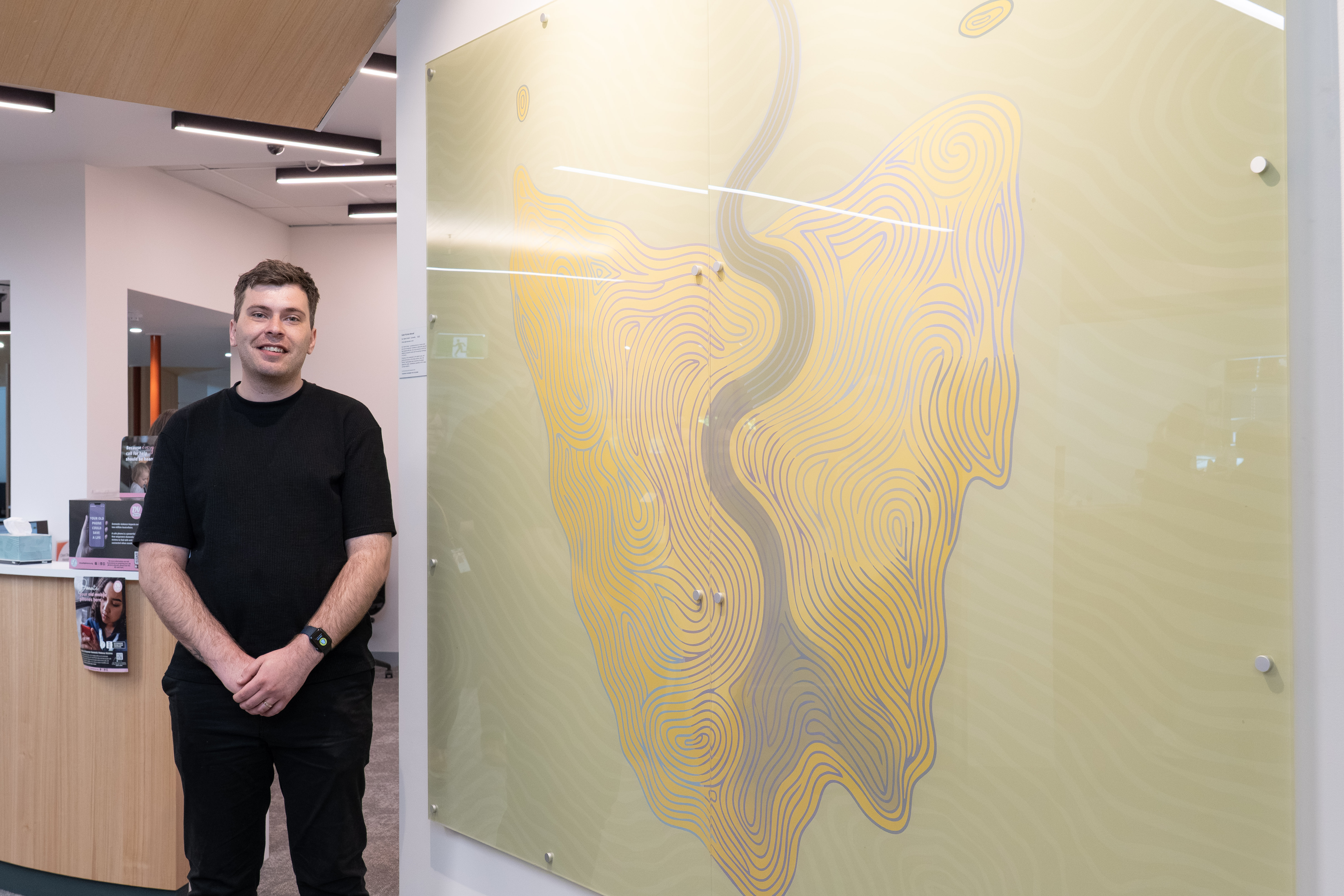
Caleb Nichols-Mansell and his artwork Our Island Home at Alanvale Campus.
In the Health Hub, the forms of Community Interwoven as Countryinterlock like woven fibres, river systems and neural pathways. “It’s a reminder that health is relational: between people, between community, and between us and the lands and waters that sustain us,” Caleb said.
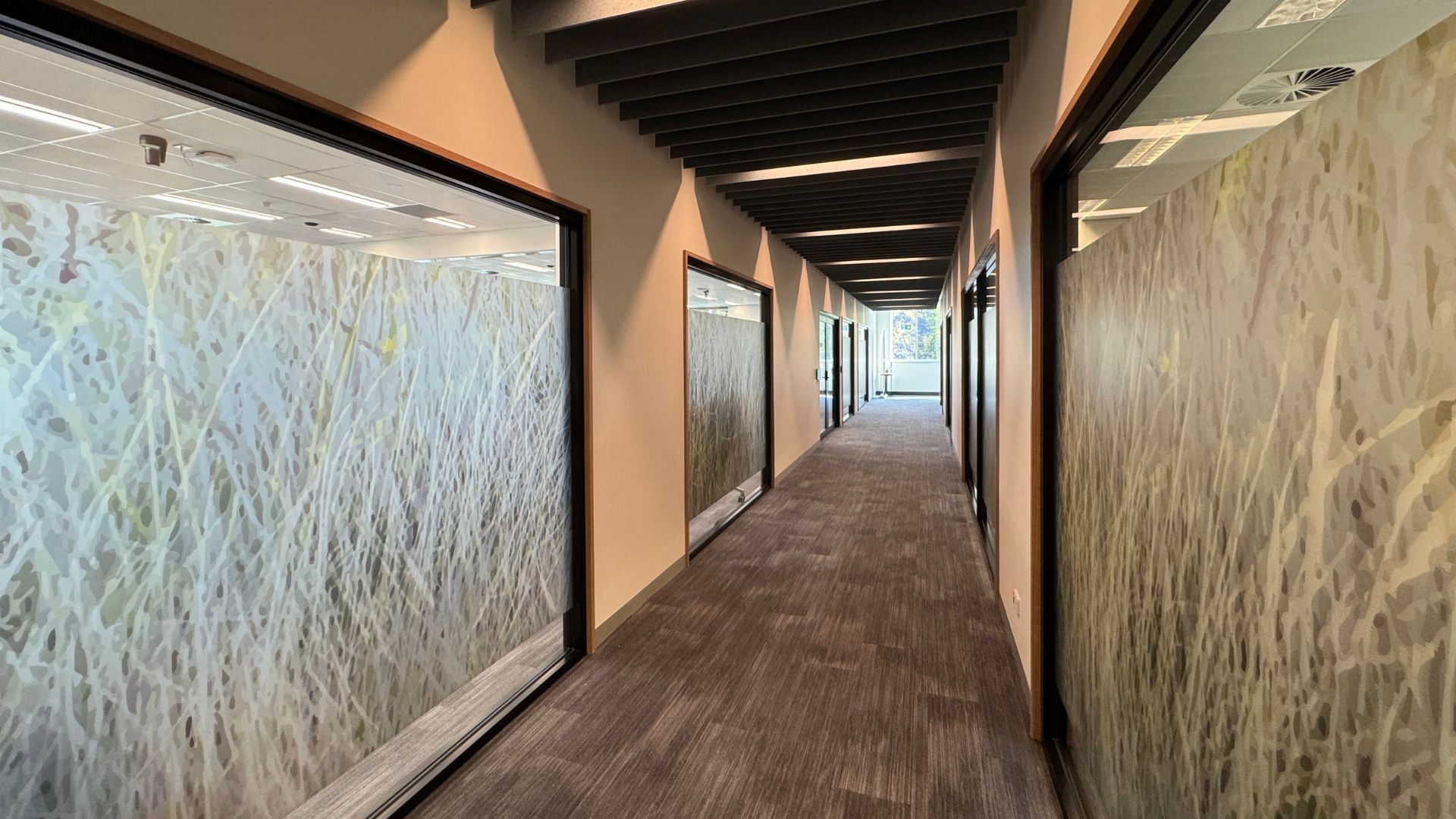
Community Interwoven as Country by Caleb Nichols-Mansell in the Health Hub at Alanvale Campus.
On a personal level, these interpretations run even more deeply for Caleb.
“I studied at TasTAFE as a young person, so to come back years later and see TasTAFE investing in Aboriginal art and stories as a central part of this campus is quite emotional,” Caleb said.
“Having Tasmanian Aboriginal visual language embedded at the heart of the campus, not tucked away on the margins, shows that TasTAFE is taking seriously its role in truth-telling, representation, and creating culturally safe environments.
“This isn’t just symbolic – it shifts how people feel when they walk through the door.”